The Comedy of Errors
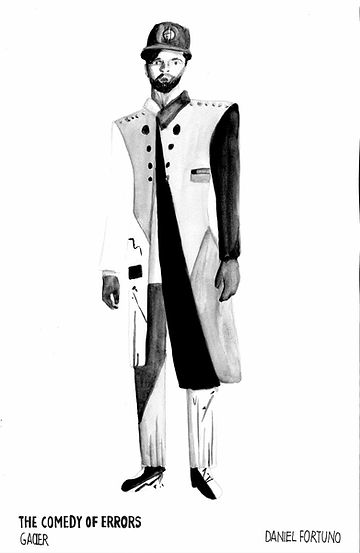
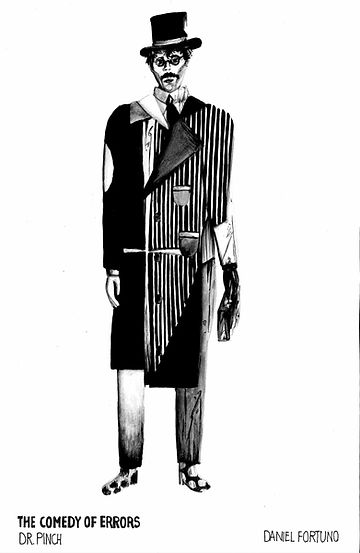
For my costume designs for The Comedy of Errors, we were given primary constraints in class that required the entire color story to exist in grayscale, inspired by the look and language of 1920s film. In my research, I became increasingly drawn to the delicate granularity and soft speckling produced by early photochemical processes used in film. There is something undeniably beautiful about those textures, and give an immediate visual cue that the image belongs to another time. I wanted my designs to carry that same sense of age, tactility, and nostalgia.
Working without color meant that silhouette became my most powerful tool. I focused on strong, graphic shapes that could clearly distinguish characters while still living within the monochromatic palette. Setting the production in Sweden led me to the work of Gösta Adrian-Nilsson, whose blend of cubism and futurism reshaped Swedish art. His abstracted figures and fractured forms deeply influenced my approach, encouraging me to push the shapes of garments into more expressive, unexpected territory.
Because the play is a comedy, I allowed humor and eccentricity to shape the designs. I embedded faces and playful forms into suits and garments, leaning into a slightly goofy, surreal quality that felt true to the spirit of the show. Unlike many of my previous projects, I relied less on traditional patterns and more on the silhouettes themselves to create visual rhythm. For characters with fewer resources, such as Aegeon, I introduced more literal patterning to suggest a life of travel—someone who carries their history and their belongings with them in every stitch.
This project became an exploration of how form, texture, and abstraction can tell a story even in the absence of color, and how old visual languages can be reimagined to bring new life to a classic comedy.
11x17 Bristol Paper, Gouache